
Table of Contents
ToggleSpace technology tools form the backbone of every successful mission beyond Earth’s atmosphere. From the satellites orbiting overhead to the rovers exploring distant planets, these tools make modern space exploration possible. Engineers and scientists rely on a wide range of equipment, some floating millions of miles away, others firmly planted on the ground. Each piece serves a specific purpose in humanity’s push to understand the cosmos.
This article examines the essential categories of space technology tools, their impact on current missions, and the innovations shaping the future. Whether someone is tracking a Mars rover or launching a new communications satellite, the right tools determine success or failure.
Key Takeaways
- Space technology tools include spacecraft, satellites, ground-based support systems, and mission control centers that work together to ensure mission success.
- Reusable rockets and CubeSat miniaturization have dramatically reduced launch costs, making space more accessible to universities and smaller companies.
- Advanced robotics and AI-powered systems extend human exploration capabilities by collecting data from places astronauts cannot reach directly.
- Emerging innovations like in-space 3D printing, nuclear thermal propulsion, and laser communication are shaping the next generation of space technology tools.
- Lunar infrastructure projects, including water extraction and habitat construction, represent a major focus for future space exploration efforts.
Key Categories of Space Technology Tools
Space technology tools fall into several distinct categories. Understanding these groups helps explain how missions come together and what equipment keeps them running.
Spacecraft and Satellite Systems
Spacecraft represent the most visible space technology tools in any mission. These vehicles carry payloads, transport astronauts, and conduct scientific research. Modern spacecraft include crewed capsules like SpaceX’s Dragon and uncrewed probes like NASA’s Voyager series.
Satellite systems serve countless functions. Communication satellites relay signals across the globe. Weather satellites track storms and climate patterns. GPS satellites provide positioning data to billions of devices. Each satellite type requires specific space technology tools for power generation, signal transmission, and orbital maintenance.
Key components within spacecraft and satellite systems include:
- Propulsion systems: Chemical rockets, ion thrusters, and solar sails move vehicles through space
- Power systems: Solar panels and nuclear generators supply electricity
- Communication arrays: Antennas and transceivers maintain contact with Earth
- Thermal control: Heaters and radiators regulate temperature in extreme conditions
- Navigation sensors: Star trackers and gyroscopes determine position and orientation
These space technology tools work together as integrated systems. A failure in one component can compromise an entire mission.
Ground-Based Support Equipment
Missions depend heavily on ground-based space technology tools. These systems handle everything from launch preparation to long-term mission control.
Launch facilities include massive structures like launch pads, fuel storage tanks, and mobile launch platforms. The Kennedy Space Center and Baikonur Cosmodrome feature some of the most advanced launch infrastructure on Earth.
Tracking stations form global networks that maintain communication with spacecraft. NASA’s Deep Space Network uses three large antenna complexes positioned around the world. This arrangement ensures continuous contact with distant missions.
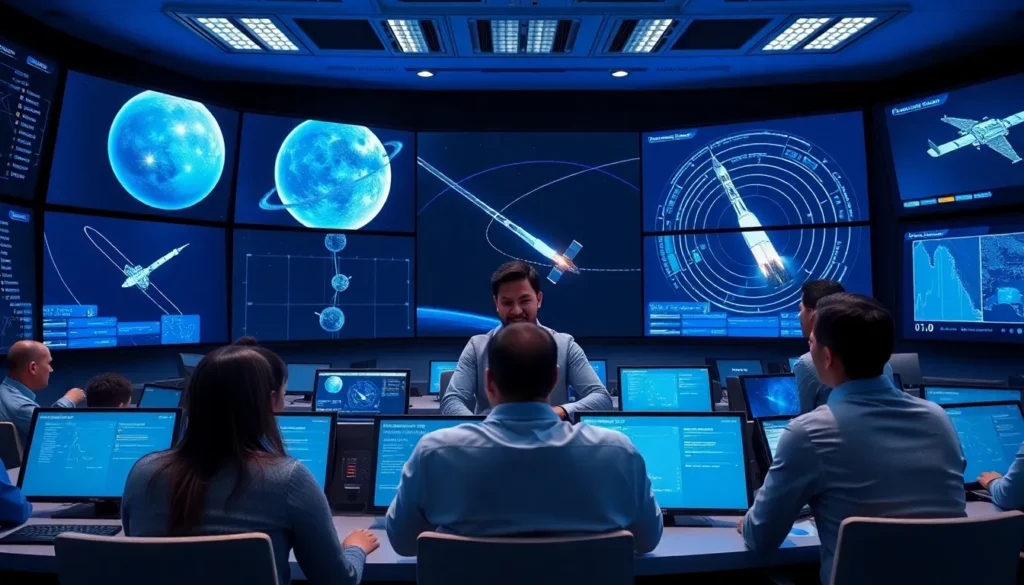
Mission control centers house the computers, displays, and workstations that operators use to monitor spacecraft. Flight controllers use specialized software to track vehicle health, adjust trajectories, and respond to emergencies. These ground-based space technology tools prove just as critical as the hardware in orbit.
How Space Technology Tools Are Transforming Exploration
Space technology tools have changed dramatically over the past two decades. These improvements enable missions that seemed impossible just a generation ago.
Reusable rockets represent one of the biggest shifts. SpaceX’s Falcon 9 boosters now land and fly again, cutting launch costs by significant margins. Blue Origin and Rocket Lab have followed with their own reusable systems. Lower costs mean more frequent launches and broader access to space.
Miniaturization has opened new possibilities. CubeSats, small satellites measuring just 10 centimeters per side, now perform tasks that once required much larger vehicles. Universities and small companies can deploy space technology tools for a fraction of traditional costs. Over 1,800 CubeSats launched between 2012 and 2023.
Advanced robotics extend human reach. The Perseverance rover on Mars carries sophisticated instruments including cameras, spectrometers, and a small helicopter named Ingenuity. These space technology tools gather data that would be impossible for astronauts to collect directly.
Artificial intelligence now assists with mission operations. AI systems help process the massive amounts of data that spacecraft collect. They can identify interesting features in images, optimize fuel usage, and even detect potential equipment failures before they occur.
Space technology tools also support Earth observation at unprecedented scales. Satellite constellations like Planet Labs’ fleet capture daily images of the entire planet. Governments and businesses use this data for agriculture, disaster response, and environmental monitoring.
Emerging Innovations in Space Technology
Several emerging technologies promise to reshape space exploration in the coming years. These innovations address current limitations and open pathways to more ambitious missions.
In-space manufacturing stands out as a game-changer. Companies are developing systems to build structures in orbit using 3D printing and automated assembly. Made In Space (now Redwire) has already demonstrated manufacturing in microgravity aboard the International Space Station. Future space technology tools could construct large solar arrays, habitats, and even spacecraft components without launching them from Earth.
Advanced propulsion systems offer faster travel times. Nuclear thermal propulsion could cut Mars transit times in half compared to chemical rockets. NASA and DARPA are jointly developing the DRACO program to demonstrate this technology by 2027. Ion propulsion continues to improve, with Hall thrusters powering missions like BepiColombo to Mercury.
Autonomous operations reduce dependence on ground control. Future spacecraft will make more decisions independently, especially important for distant missions where communication delays make real-time control impractical. These space technology tools use machine learning to adapt to unexpected situations.
Lunar infrastructure development accelerates as multiple nations plan Moon bases. NASA’s Artemis program aims to establish a sustainable presence on the lunar surface. This effort requires new space technology tools for power generation, resource extraction, and life support. Companies are developing systems to extract water ice from lunar craters and convert it into drinking water, oxygen, and rocket fuel.
Optical communication systems will replace traditional radio links for some applications. NASA’s LCRD mission demonstrated laser communication that transfers data 10 to 100 times faster than radio. This capability supports data-intensive instruments and high-definition video from deep space missions.


