
Table of Contents
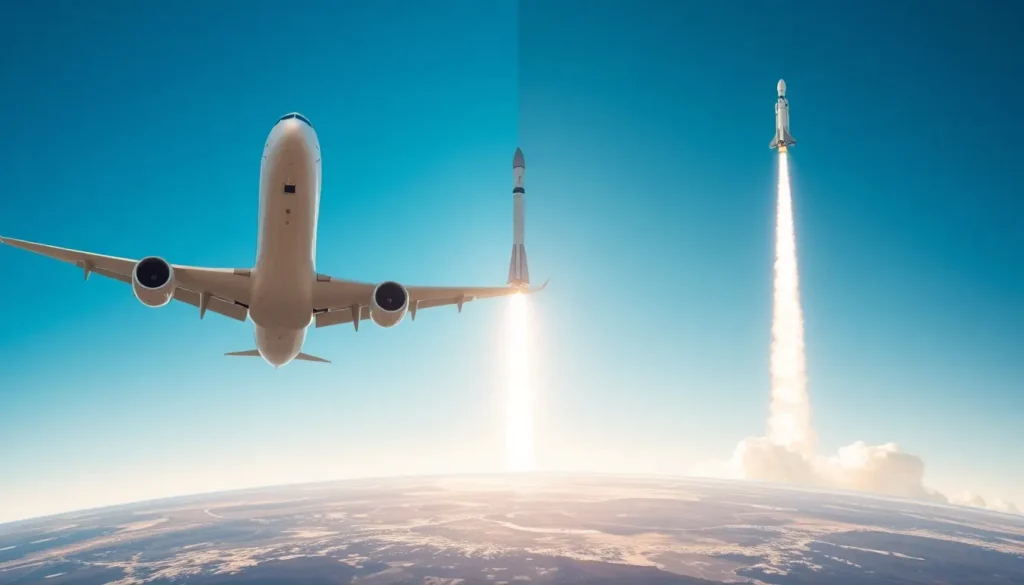
ToggleSpace technology vs. traditional aviation represents one of the most significant comparisons in modern engineering. Both fields push the boundaries of human flight, but they operate under vastly different conditions and serve distinct purposes. Aviation keeps us connected across continents. Space technology extends our reach beyond Earth’s atmosphere.
The gap between these two fields continues to narrow as private companies develop reusable rockets and high-altitude aircraft. Understanding how space technology and aviation differ, and where they overlap, helps clarify what the future holds for both industries. This comparison covers propulsion systems, engineering requirements, real-world applications, and what experts predict for the coming decades.
Key Takeaways
- Space technology operates beyond Earth’s atmosphere using self-contained propulsion, while aviation relies on atmospheric air for lift and thrust.
- Speed requirements differ dramatically—commercial aircraft cruise at 500–600 mph, whereas space technology demands 17,500 mph or more to maintain orbit.
- Reusable rockets from companies like SpaceX are bridging the gap between space technology and aviation engineering principles.
- Space technology quietly powers everyday life through GPS navigation, weather forecasting, and global communication satellites.
- Hypersonic aircraft and suborbital flights may soon blur the line between space technology and traditional aviation, potentially reducing intercontinental travel to under an hour.
- Private investment exceeding $15 billion in space technology (2021) is accelerating innovation faster than government programs alone.
Understanding Space Technology and Aviation
Space technology encompasses all systems designed to operate beyond Earth’s atmosphere. This includes rockets, satellites, space stations, and deep-space probes. The defining characteristic? These systems must function in a vacuum where traditional aircraft simply cannot survive.
Aviation, by contrast, depends entirely on Earth’s atmosphere. Commercial jets, helicopters, and military aircraft all use air for lift and propulsion. A Boeing 787 cruises at roughly 35,000 feet. The International Space Station orbits at 250 miles above Earth, about 40 times higher.
The distinction matters because it shapes everything from fuel requirements to vehicle design. Space technology must account for extreme temperature swings, radiation exposure, and zero gravity. Aviation engineers focus on aerodynamics, fuel efficiency, and passenger comfort within atmospheric conditions.
Both fields share a common ancestor in aerospace engineering. They borrow techniques from each other regularly. But the operational environments create fundamentally different engineering challenges that define each industry.
Core Technical Differences
The technical gap between space technology and aviation shows up most clearly in speed requirements, structural design, and operational costs.
Speed tells much of the story. Commercial aircraft typically cruise between 500 and 600 mph. Space technology demands speeds of roughly 17,500 mph just to maintain low Earth orbit. The Saturn V rocket that carried Apollo astronauts reached 25,000 mph to escape Earth’s gravity entirely.
Structural requirements differ dramatically as well. Aircraft must withstand repeated pressurization cycles and aerodynamic stress. Spacecraft face thermal extremes ranging from -250°F in shadow to +250°F in direct sunlight. They also endure intense vibration during launch and reentry forces that would destroy any conventional aircraft.
Cost comparisons reveal another stark contrast. A typical commercial flight costs airlines roughly $30 per mile traveled. Space technology launches can exceed $10,000 per pound delivered to orbit, though SpaceX has reduced this figure significantly with reusable rockets.
Propulsion and Engineering Requirements
Propulsion systems represent the clearest technical divide between space technology and traditional aviation.
Jet engines power most commercial aircraft. These engines intake atmospheric air, mix it with fuel, and produce thrust through combustion. This process requires oxygen from the surrounding atmosphere. It’s efficient, reliable, and well-understood after decades of refinement.
Space technology cannot rely on atmospheric oxygen. Rocket engines carry both fuel and oxidizer onboard. The Space Shuttle’s main engines burned liquid hydrogen and liquid oxygen. Modern SpaceX Merlin engines use refined kerosene with liquid oxygen. This self-contained approach enables operation in the vacuum of space but dramatically increases fuel weight and cost.
Engineering requirements extend beyond propulsion. Aviation designs prioritize durability and maintenance accessibility. Airlines expect aircraft to fly thousands of flights over 20 to 30 years. Space technology has historically treated vehicles as expendable. Each Saturn V rocket flew exactly once.
Reusable space technology is changing this calculus. SpaceX’s Falcon 9 boosters have landed and relaunched over 20 times. Blue Origin tests reusable systems as well. This shift brings space technology engineering closer to aviation principles, designing for multiple uses rather than single missions.
Applications and Impact on Modern Life
Space technology and aviation both shape daily life in ways most people never notice.
Aviation moves 4.5 billion passengers annually. It enables global commerce, tourism, and emergency response. Express shipping services depend on cargo aircraft. Medical organs reach recipients via chartered flights. The aviation industry employs millions directly and supports countless related businesses.
Space technology operates more quietly but just as pervasively. GPS satellites guide smartphone navigation and airline routing alike. Weather satellites provide the forecasts that help airlines avoid storms. Communication satellites enable video calls, news broadcasts, and internet access in remote areas.
The practical applications continue expanding. Space technology now monitors climate change through Earth observation satellites. It tracks deforestation, measures ice cap thickness, and identifies pollution sources. Aviation cannot perform these functions, aircraft lack the altitude for global-scale observation.
Military applications drive investment in both fields. Fighter jets and bombers represent cutting-edge aviation technology. Space technology provides surveillance, secure communications, and missile early warning systems. The U.S. Space Force, established in 2019, reflects the growing strategic importance of orbital assets.
Commercial crossover is increasing. Companies like Virgin Galactic and Blue Origin sell suborbital space tourism flights. These trips blur the line between aviation and space technology. Passengers experience weightlessness and see Earth’s curvature before returning to conventional airports.
The Future of Space Technology and Aviation
The next two decades will reshape both space technology and aviation in significant ways.
Aviation faces pressure to reduce carbon emissions. Electric and hydrogen-powered aircraft are under development. Airbus aims to introduce a hydrogen-fueled commercial aircraft by 2035. Sustainable aviation fuels are gaining market share. These changes will transform propulsion systems that have remained largely unchanged since the 1960s.
Space technology is entering a commercial boom. SpaceX plans regular Mars missions within this decade. Amazon’s Project Kuiper and SpaceX’s Starlink are deploying thousands of internet satellites. Space manufacturing, producing materials in microgravity, is moving from experiments to commercial operations.
The boundaries between space technology and aviation may blur further. Hypersonic aircraft under development could travel at speeds exceeding Mach 5. Point-to-point suborbital flights might reduce New York to Tokyo travel time from 14 hours to under an hour. These vehicles would operate as both aircraft and spacecraft during different flight phases.
Private investment is accelerating both fields. Venture capital flowing into space technology exceeded $15 billion in 2021. Electric aviation startups attracted billions more. This funding fuels innovation at rates government programs alone could not sustain.
Workforce demands are shifting accordingly. Aerospace engineering programs now emphasize cross-disciplinary training. Engineers may work on commercial jets early in their careers and space technology systems later, or simultaneously.


